
 admin
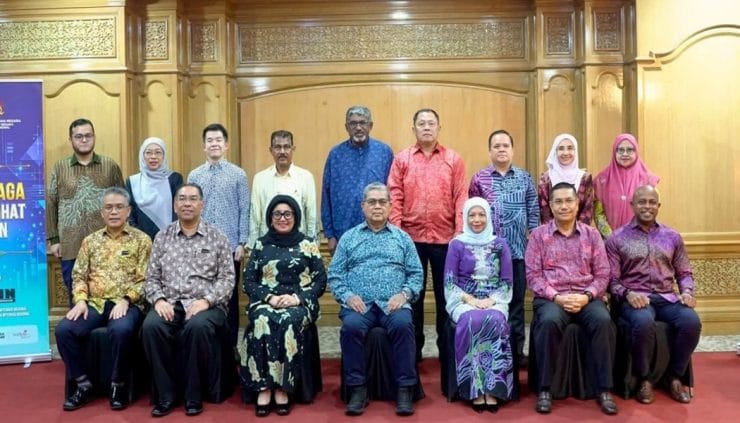
KUALA LUMPUR, Oct 22 (Bernama) — A total of 20 individuals comprising academics, representatives of non-governmental organisations (NGOs) and government agencies, with expertise in various fields, have been appointed to the Advisory Board (LPI) of the National Integration Research and Training Institute (IKLIN) for the 2026-2028 session.
In a statement, the National Unity Ministry (KPN) said all appointees received their letters of appointment from National Unity Minister Datuk Aaron Ago Dagang at the Department of Museums Malaysia here today.
Among those appointed are Deputy National Unity Minister Yuneswaran Ramaraj as alternate chairman, KPN secretary-general Datuk Haslina Abdul Hamid, as well as academics such as Universiti Sains Malaysia School of Social Sciences lecturer Prof Datuk Dr Sivamurugan Pandian and Universiti Malaya Malay Studies Academy dean, Prof Datuk Dr Awang Azman Awang Pawi.
KPN said LPI serves as a strategic advisory mechanism for IKLIN, providing views, strategic direction and recommendations to improve the implementation of training, research and competency development functions in the fields of national unity and integration.
“LPI’s cross-sectoral membership can contribute expertise, perspectives and strategic ideas to IKLIN, as a Centre of Excellence for Unity, in identifying the best approaches to address racial issues, hate speech, social conflicts and various challenges that could undermine social harmony.
“The diverse backgrounds of LPI members will help ensure that every issue related to unity can be assessed comprehensively, taking into account research, data analysis, administrative experience and the current social landscape,” it said.
Meanwhile, Aaron, in his speech at the event, said LPI should serve as a strategic advisory body and think tank for IKLIN.
“IKLIN must emerge as a Centre of Excellence and a national reference centre in the fields of unity, national integration and nation-building,” he said.
In this regard, Aaron outlined five strategic directions to ensure IKLIN remains relevant and competitive by 2027, including institutional transformation and the rebranding of IKLIN, as well as benchmarking against international institutional models.
The other strategic directions include expanding domestic and international academic collaboration through memoranda of understanding (MoUs), and strengthening the Open Data Ecosystem in collaboration with the Ministry of Economy and the Department of Statistics Malaysia (DOSM).
“Fifth, IKLIN must strengthen its Future Research Agenda, covering issues such as social polarisation, identity politics, generation gap, social mobility, digital literacy, artificial intelligence (AI) and community resilience,” he said.
— BERNAMA