
 admin
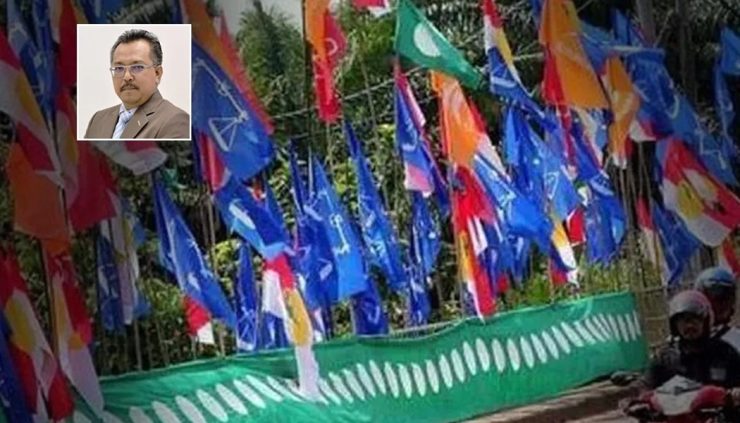
adminKUALA LUMPUR: The people deserve to know who the future prime minister will be before Parliament is dissolved, not after closed-door negotiations if the Barisan Nasional (BN) and PAS coalition succeeds in forming a government after the 16th General Election (GE16), from an accountability perspective.
Dean of the Ghazali Shafie Centre for Graduate Studies in Government (GSGSG), Universiti Utara Malaysia (UUM), Prof Dr Rusdi Omar said the coalition does not necessarily have to name a candidate for prime minister now, but there needs to be a candidate named at the latest before Parliament is dissolved given that the term will end in December 2027.
He stressed that at the very least, BN and PAS need to announce a formula such that the party that wins the most seats can name their prime minister even if they cannot agree on the name of the candidate.
“If not (name a prime ministerial candidate), it’s like voters are being asked to sign a blank cheque,” he said in a statement today.
Previously, Amanah Vice President Mahfuz Omar said that his party urged PAS to state its stance on whether it was willing to accept UMNO President Datuk Seri Ahmad Zahid Hamidi as prime minister if BN and Perikatan Nasional (PN) formed a government after the 16th general election.
Mahfuz raised the question following political analyst Ong Kian Ming’s prediction that Ahmad Zahid could potentially gain the support of Sabah and Sarawak to become prime minister if BN and PAS or PN form a government after the next general election.
However, Dr. Rusdi explained that, if according to the Federal Constitution, there is actually no obligation for any party to nominate a prime ministerial candidate before the election as subject to Article 43(2)(a), which is that the Agong appoints a Member of the Dewan Rakyat who in his opinion has the confidence of the majority.
He said it was customary for coalition parties to nominate prime ministerial candidates, as was done by Pakatan Harapan (PH) which nominated Tun Dr. Mahathir Mohamad in the 14th general election.
In GE15, he said, all coalitions had their ‘ poster boys ‘ such as Datuk Seri Anwar Ibrahim, Tan Sri Muhyiddin Yassin and Datuk Seri Ismail Sabri Yaakob.
“We have already felt for ourselves that in 2022, if there is not a coalition with enough 112 seats, the situation will become uncertain.
“For BN and PAS, I see three things, first, they are in a dilemma. If they are named too early, the cooperation that has not yet been finalized could be broken. Just look when Bersatu named Muhyiddin as the 11th PM candidate, the PAS leaders themselves were seen as unhappy.
“But if we remain silent, our opponents will continue to attack this issue. PAS itself once said they have their own prime ministerial candidate,” he said.
Dr. Rusdi also commented on the issue of the court case involving Ahmad Zahid, he said, in terms of law, he had never been convicted and was granted a discharge without acquittal (DNAA) for 47 charges in the Akalbudi Foundation case in September 2023, in addition to the Attorney General’s Chambers (AGC) deciding no further action (NFA) on January 8, 2026.
“However, the decision is still being challenged by the Bar Association in court. So the issue is not law, but perception and integrity, and that could affect the support of voters on the fence as well as the grassroots of PAS,” he said.
At the same time, he said, the Sabah and Sarawak coalition parties need to be taken into account because they hold 56 of the 222 seats, or approximately 25 percent of the total.
He stressed that this situation would create difficulties in forming a government if the Borneo bloc itself did not accept the name of the proposed prime minister candidate.
-Agency